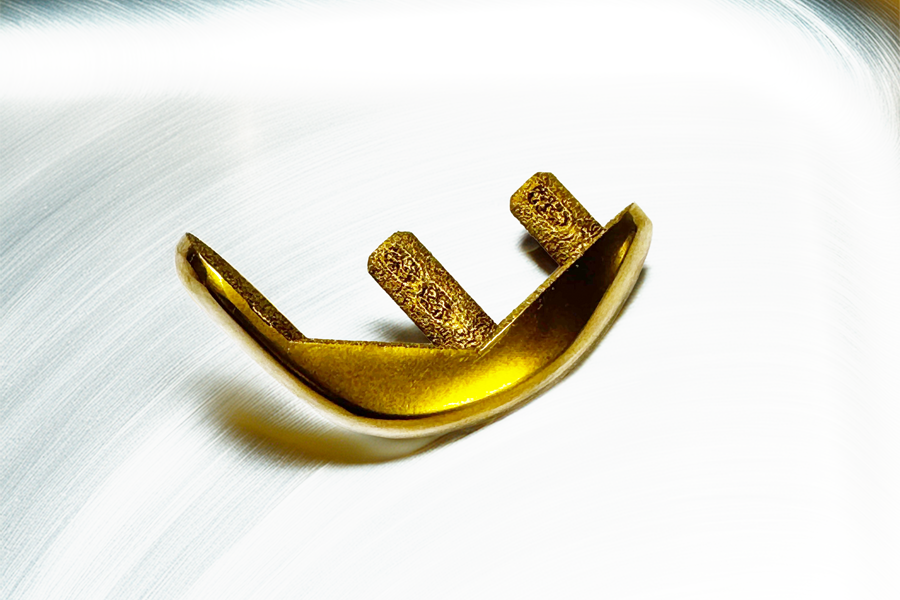
Quintus Technologies, Croom Medical, and Uppsala University have achieved promising results in improving titanium’s wear resistance through Hot Isostatic Pressing (HIP).
By integrating nitriding directly into the HIP process, researchers created a harder, more wear-resistant surface without a separate coating step. Initial laboratory tests showed lower friction and wear resistance comparable to or potentially better than cobalt-chromium (CoCr).
This approach could expand the use of titanium in orthopaedic implants while simplifying manufacturing and reducing costs. Further tests are planned, with new results expected in 2027.
Addressing material challenges in joint replacements
Cobalt-chromium (CoCr) alloys are widely used in joint replacements because of their strength and wear resistance. However, long-term wear can release metallic particles that may contribute to inflammation and implant loosening.
Titanium is already widely used in medical implants due to its biocompatibility and mechanical properties. Yet its relatively low surface hardness and wear resistance limit its use in joint replacement surfaces where components experience continuous friction.
Surface treatments can improve titanium’s wear resistance, making it a potential alternative to CoCr in these applications. However, conventional methods often require additional processing steps, specialized equipment, and lengthy treatment times. This adds complexity and cost to implant manufacturing.
Integrating surface treatment directly into Hot Isostatic Pressing (HIP) could offer a more efficient approach.
Combining surface treatment and HIP in one process
Quintus Technologies, together with Croom Medical and Uppsala University, investigated a different approach: creating a hard, wear-resistant surface on titanium during HIP.
By introducing nitrogen during HIP, researchers formed a thin titanium nitride layer directly on the surface of titanium components. This layer gives the material its distinctive golden appearance while improving surface hardness and wear resistance.
Unlike conventional coatings applied in a separate manufacturing step, this approach modifies the titanium surface during HIP.
Using Quintus High Pressure Heat Treatment (HPHT™), the process offers the potential to combine material densification, heat treatment, and surface modification in a single cycle. This could reduce additional processing steps, shorten production times, and lower manufacturing costs.
The study also demonstrated the importance of HIP atmosphere control. Quintus Purus® technology helped maintain low moisture levels during processing, resulting in a more uniform golden surface with less discoloration.

Promising results for implant performance
The initial laboratory tests showed improvements in several key properties:
- Higher surface hardness: Most nitrided titanium samples reached 650–750 HV, showing a clear improvement over untreated titanium.
- Lower friction: During initial testing, nitrided titanium showed approximately half the friction of cobalt-chromium (CoCr).
- Better wear resistance: Wear on the nitrided titanium samples was too small to measure accurately, suggesting wear resistance at least comparable to CoCr under the tested conditions.
- More uniform surface appearance: Quintus Purus® helped reduce discoloration, producing a more consistent golden finish on the treated titanium.
These findings show the potential of nitriding during HIP to improve titanium surface properties. Further testing is needed to assess long-term performance and suitability for medical implants.
Advancing medical manufacturing through collaboration
The study brought together three organizations with complementary expertise: Quintus Technologies, specializing in high-pressure technology; Croom Medical, contributing expertise in medical device manufacturing; and Uppsala University, with expertise in biomedical engineering.
The research was conducted by Matilda Karlsson and James Shipley from Quintus Technologies, Francesco D’Elia from Uppsala University’s Division of Biomedical Engineering, and Shane Keaveney from Croom Medical in Ireland.
Together, the partners explored how advanced HIP technology could improve titanium implant performance while reducing the need for separate surface treatments.
Next steps: Further testing and results expected in 2027
Building on these initial findings, the next phase of research will focus on refining the nitriding process.
Upcoming tests will investigate different furnace conditions, processing temperatures, and cooling rates. The aim is to better understand how these factors affect the surface properties of titanium and improve process consistency.
To suppor this, Quintus Technologies is also offering a master’s thesis opportunity focused on further developing the nitriding process for titanium medical implants.
Learn more about the master’s thesis opportunity.
New results are expected in 2027, providing further insight into the potential of this approach for medical implant manufacturing.